06 · URIEL First Response
Your real first response.
For the crews who arrive at the worst hour of a stranger’s life on a shift rotation, and for the voices who hear all of it and are never told how it ended.
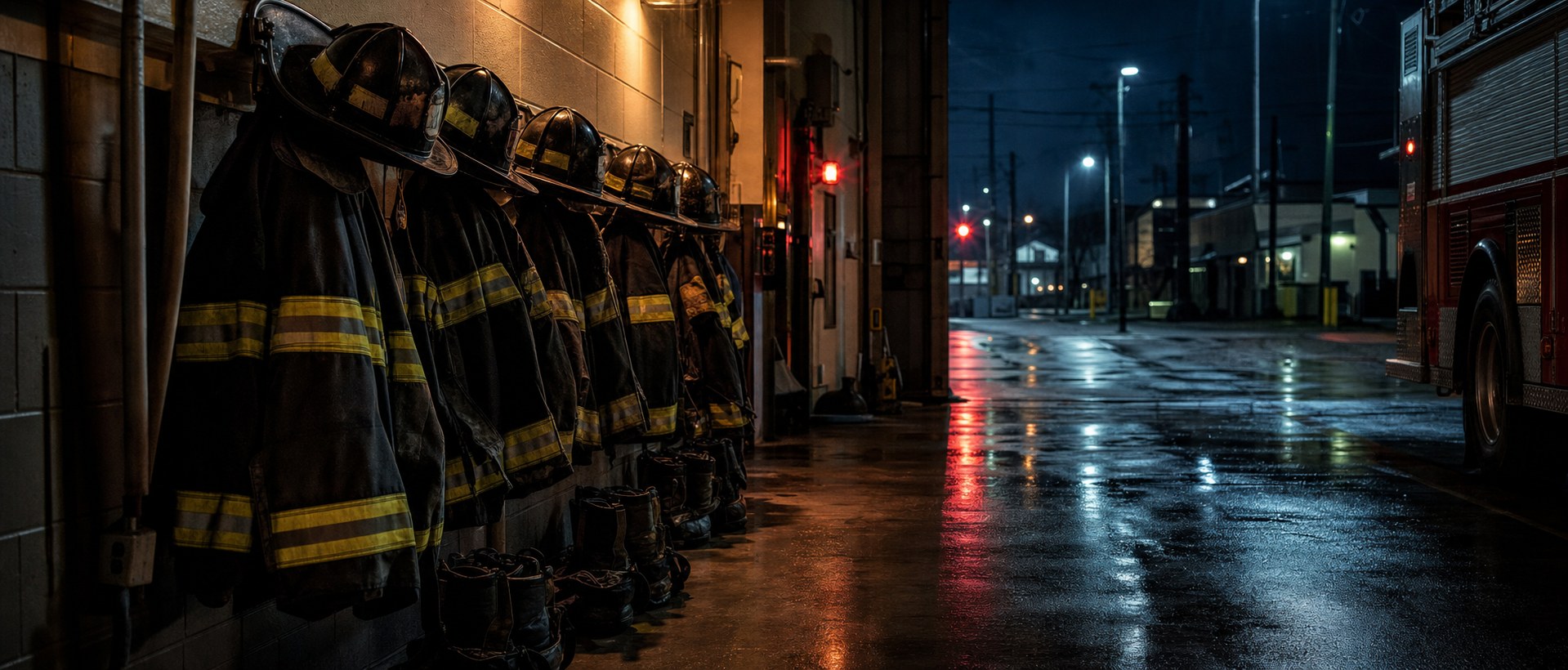
The indigenous problem
What this environment actually does to people
Fire, EMS, and emergency communications are three occupations, not one. One figure from each, because a single number flattens the distinction that matters most here.
46.8%
Of firefighters in a national sample reporting suicidal ideation at some point in their fire service career.
Journal of Affective Disorders, 2015 (n = 1,027)
2.2×
The odds of a reported medical error among EMS clinicians classified as fatigued, against those who were not.
Prehospital Emergency Care, 2012 (n = 511)
17–24%
Of 911 telecommunicators screening positive for post-traumatic stress symptoms — a population physically present at none of it.
Journal of Traumatic Stress, 2012; CDC / NIOSH
Two tracks, one environment
One incident, carried in two places.
Track A
The crew
Recovery is not scheduled. The next tone drops on its own timetable, and it does not consult the last one.
A twenty-four hour tour is not twenty-four hours of work. It is twenty-four hours in which sleep is permitted but never protected. The next tour starts wherever the last one left the body.
The cost shows up in the work. Fatigued EMS clinicians run more than double the odds of a reported medical error — in a moving vehicle, in a stranger’s hallway, with drug maths done from memory at four in the morning.
And the unit is small. A paramedic coming apart is coming apart in front of the two people he is locked in a cab with for the rest of the tour.
Track B
The console
They are exposed to the whole of it and present at none of it, and nobody comes back to tell them how it ended.
The breathing that stops mid-sentence. The parent who cannot be talked through compressions. The officer who stops answering. Then the line closes and the next one opens.
There is no scene to leave, no ride back to quarters, no colleague who was also standing there. The research is clear that presence is not required to accumulate the risk.
In the federal government’s own catalogue of occupations, they are still filed under office and administrative support. The Senate voted unanimously to change that in September 2025. The House has not.
Journal of Traumatic Stress, 2012; U.S. Standard Occupational Classification 43-5031; Enhancing First Response Act, S.725
What changes
The same tour, with the fatigue accounted for.
One button, in the ear, in the bay or in the cab. No appointment, no peer-support referral, nothing that goes to the officer in charge and nothing in a file. URIEL knows this person’s blind spots, values, triggers and what they need in order to believe they did the job well — established through structured assessment at onboarding, not inferred from what they type. The service sees none of it. In a culture where being seen to need help is itself a risk, that is not a detail. It is the entire difference between a program that exists and one that is used.
Hour nineteen of a twenty-four.
Sleep-deprived brains show roughly 60 percent greater amygdala response to negative material, with the prefrontal connection that normally moderates it measurably weakened.
Yoo, Gujar, Hu, Jolesz & Walker, Current Biology, 2007, N = 26
The system knows what hour it is and what that does to this particular person. Support calibrated to the state he is actually in, not the one the roster assumes.
The one that does not wash off.
Debriefs are scheduled, optional and observed. The interval between the call and the conversation is where the damage consolidates.
It gets addressed in the hours that matter, unobserved, before it becomes the thing he stops talking about. Repeated contact is what moves the outcome, not one contact.
The console.
Present for all of it, at the scene for none of it, and nobody rings back to say how it ended. Still classified federally as administrative support.
Treated as exposed personnel, because the evidence says they are. The unresolved calls get somewhere to go instead of accumulating unnamed.
You cannot roster your way out of physiology. You can give people a way to work with the state the roster puts them in.
Why it holds
It does not make the crew less tired. It is built to bring the decision back to the deliberate reasoning that fatigue takes first.
The section that follows is the same on every URIEL page, and deliberately so. The environments differ. The physiology does not.
Under acute stress the prefrontal cortex — the part of the brain that holds several options in mind at once and weighs them against each other — measurably loses ground to faster, cruder threat circuitry. Working memory narrows. Cognitive flexibility drops. This is not a character failure and it is not a training gap. It is physiology, and it arrives precisely when the decision is most expensive.
Arnsten, Nature Reviews Neuroscience, 2009 and Nature Neuroscience, 2015; Shields, Sazma & Yonelinas, meta-analysis, Neuroscience & Biobehavioral Reviews, 2016
01
It gets said while it is still live.
Not at the end of a tour, on a form. In the bay, between the last call and the tone that has not gone off yet. Putting an internal state into words recruits prefrontal regulation over the threat response, measured in imaging rather than asserted in training.
Lieberman et al., Psychological Science, 2007; Torre & Lieberman, Emotion Review, 2018
02
The medic steps outside the call.
Being inside an event and looking at one are different cognitive positions, and the second reasons better. It is why a crew will talk a colleague through their worst job with complete clarity and carry their own in silence.
Powers & LaBar, meta-analysis, Neuroscience & Biobehavioral Reviews, 2019; Crane et al., Stress and Health, 2022
03
The options are made legible. The crew member still decides.
URIEL gives no clinical or operational direction. It makes the alternatives visible — say something now, call it at the end of the tour, or take the day that is owed — and leaves the choice where the consequence sits. Change a person arrives at holds. Change handed to them does not.
Deci & Ryan, self-determination theory; Magill et al., 36 studies, N = 3,025, J. Consulting and Clinical Psychology, 2018
04
It happens again, and the capacity grows.
Regulation is a trainable capacity, not a temperament. In the training studies a single session’s effect is still measurable a week later, and it transfers to situations that were never rehearsed. Those were structured laboratory protocols. What repetition does across a rotation of nights is the question our trial is designed to answer.
Schweizer et al., Journal of Neuroscience, 2013; Hermann et al., N = 85, SCAN, 2020; Denny et al., Psychological Science, 2015
These are established mechanisms in the published literature, and each is cited above. What the literature does not yet contain is a trial of the assembled capability in a fire and EMS service. That study is designed and is the next step, and we would rather say so than imply otherwise. The full evidence base, with the limits stated.
The return
What the service gets for it.
Self-efficacy is the lever, and it is measurable.
Across 114 studies and 21,616 people, belief in one’s own capability tracked a performance gain of roughly 28 percent — against 10.4 percent for goal-setting and 13.6 percent for feedback. It is the largest single psychological lever in the organizational literature, and no service is currently resourced to move it.
Stajkovic & Luthans, meta-analysis, Psychological Bulletin, 1998
Structured reflection is not soft. It has effect sizes.
Meta-analysis puts goal-directed self-regulation at g = 0.74, the largest gain of any outcome category studied. Restricted to randomised controlled trials only, the overall effect holds at g = 0.59 across 2,528 participants. Moderate, replicated, and pointed at the judgment a tour of nights erodes.
Theeboom, Beersma & van Vianen, 2014; Kleingeld et al., RCT-only meta-analysis, N = 2,528, 2023
Availability is not a convenience feature. It is the dose.
In the motivational-interviewing literature, 87 percent of studies with more than five contacts showed an effect. With a single contact, only 40 percent did. A critical-incident debrief is one contact, and it happens afterwards. This is available every tour, including between calls.
Rubak et al., 72 randomised controlled trials, British Journal of General Practice, 2005
The constraints we design around
What this environment will not tolerate.
URIEL™ is built to an environment, not adapted into one. The limitations below are not obstacles to a general product; they are the specification for this one.
The quiet interval is not allocated
Anything requiring an uninterrupted block has assumed a portion of the tour that does not exist and cannot be forecast. The tone sets the schedule, and nothing else does.
Quarters are shared
There is no private room in a station or an ambulance bay. Anything that has to be done where colleagues cannot see it being done will not be done at all.
Most of the service has no budget line
More than sixty percent of U.S. firefighters are volunteers and roughly eighty percent of departments are all or mostly volunteer. Anything priced for a metropolitan agency has excluded most of the profession.
The institutional case
The institutional case
What the service is actually buying.
No chief is short of reasons to care about his people. He is short of one that survives a county budget hearing in a bad year.
-
01
The console you cannot staff is the operating problem.
Roughly twenty-five percent average vacancy across 774 centers. 3,952 departures in one year. Better than one in five trainees fails to finish. The short console gets covered by mandatory overtime, which is what created the shortage. It is a loop, and it is running now.
IAED / NASNA via the National 911 Program, 2023; NENA and Carbyne, 2025
-
02
EMS turnover has a price per head, paid again every year.
Roughly seventy-one thousand dollars a year per agency, just under seven thousand per termination, and forty-five percent of respondents intending to leave the profession inside six years. None of that prices the twelve years of judgment that walks out with the person.
Prehospital Emergency Care, 2010; National Association of Emergency Medical Technicians, 2022
-
03
The federal category exists and has been raised in priority.
Behavioral health is a Priority 1 Wellness and Fitness activity under FEMA’s Assistance to Firefighters Grant, open to fire departments and non-affiliated EMS, and FEMA elevated the whole element in the latest cycle. Whether a given procurement fits a given year’s notice is a question for a grants officer. The point for a chief is narrower: the line item does not have to be invented at a council meeting.
FEMA, Assistance to Firefighters Grant Program, FY2025 Notice of Funding Opportunity
-
04
Buying it and having it used are two purchases.
Services have paid for member support before and watched the number stay pinned to a noticeboard for years. Not indifference — a paramedic’s certification is a state license and a firefighter’s duty status is a medical determination, so anything that could surface in front of either process is correctly treated as a hazard. That is why the data boundary here is architecture, and why rollout starts with the crews.
Adjacent environments
Built separately, and standing next to this one.
URIEL is specified separately for every environment it enters. Two of them meet yours at the scene and at the door.
Begin an institutional conversation.
Deployments are scoped with the institution, under its governance, and inside its data protection posture.
Begin an Institutional Conversation