URIEL Health — Clinical Decision Infrastructure
The baseline keeps moving.
When a disease changes someone in increments, the hardest part is that the baseline keeps moving. Families and clinical teams are forced to make long-term legal, medical and institutional calls while navigating sustained grief.
The mechanism underneath
Why judgment drifts when the disease does
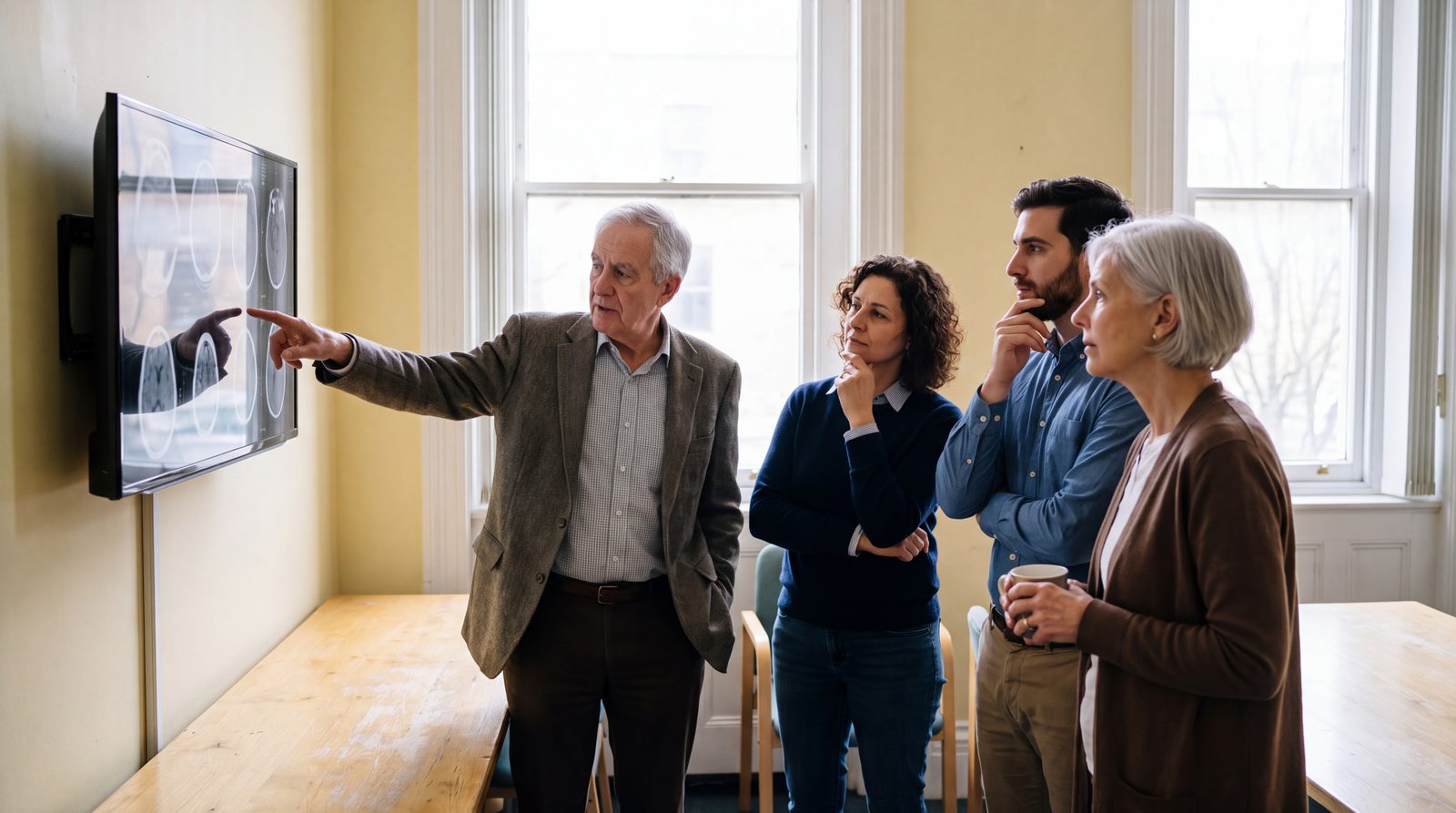
Neurodegenerative care is decided across years by people who see it in fragments. A neurologist sees a clinic interval. A physiotherapist sees function. A daughter sees the whole thing and is the only one present for all of it, which is also why she is the most depleted person in the conversation.
Sustained stress does not make anyone less intelligent. It narrows the window a decision is judged against. Under load, the most recent observation is weighted far above the trajectory, and a bad fortnight begins to look like a new baseline. Decisions about driving, residence and capacity then get made against the fortnight rather than the arc.
The second effect is quieter. Grief that has nowhere to go attaches itself to whatever decision is nearest, and the family argues about the care home when the argument is actually about loss.
The five-stage method
How URIEL works on this decision.
URIEL stabilises decision-making across extended care horizons, decoupling reactive emotional stress from the structural protocols required to preserve dignity and quality of life.
01
Discover
What has actually changed, and over what period — separated from what changed this week.
02
Decode
Which part of the difficulty is the disease, which is the system around it, and which is grief looking for a target.
03
Determine
The decision weighed against the trajectory and its second-order consequences, not against the most recent visit.
04
Deploy
A decision the family and the clinical team can both state, with the reasoning attached to it.
05
Develop
A record of why, so the next decision starts where this one finished instead of from the beginning.
Discover, Decode, Determine, Deploy and Develop are the five stages of the sequencing method described in URIEL’s patent application. U.S. Patent Pending. The science sets out the evidence base.
Begin a conversation about this.
Engagements are scoped with you directly, in confidence, and at whatever pace the decision allows.