01 · URIEL Oncology
Your real oncology.
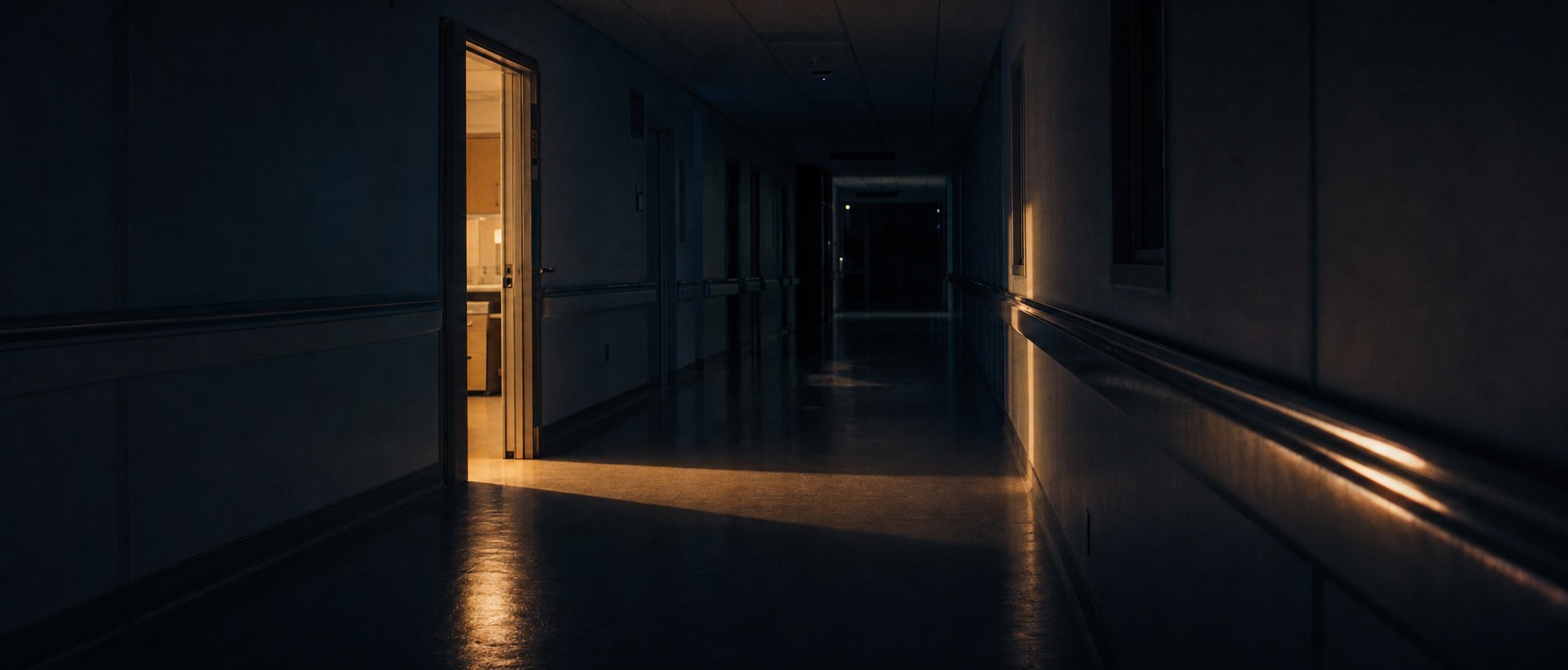
A clinician delivers the news. A family receives it. Both go home carrying it, and neither one has anywhere to set it down.
The indigenous problem
What this environment actually does to people
These are not soft numbers from an engagement survey. They are published prevalence figures from the clinical literature, and they describe the working conditions URIEL is designed to enter.
62.79%
Burnout prevalence among oncology nurses.
Journal of Clinical Nursing, 2021
49.3%
Burnout among hematology and oncology physicians.
American Medical Association, 2024
~2 hrs
Of documentation for every one hour of direct patient care.
Annals of Internal Medicine, 2016
Two tracks, one environment
The same disease is carried by two different people.
Track A
The clinician
Empathic distress is not a character flaw. It is a predictable physiological consequence of absorbing suffering without a mechanism to metabolise it.
The injury is more specific than exhaustion. A clinician often knows what the right care is and cannot provide it, because the decision was bounded by people who will never meet the patient and do not carry the outcome — a utilisation rule, a denial, a template. Then the other half of the day: telling a family the cancer is back, or that a child is going to die. Then the next room.
- Restores the capacity to remain present with a patient without carrying the patient home.
- Strengthens deliberate judgment at the end of a shift, when reactivity is highest and stakes have not fallen.
- Protects the clinician’s own standing as a person, not only their performance as a provider.

Track B
The family
Nobody hands you a manual for the worst year of your life.
- Supports the caregiver as a person with their own limits, not as an unpaid extension of the care team.
- Makes the shape of the year ahead legible, so that what is coming is understood before it arrives.
- Gives anticipatory grief somewhere to go, and gives the family language for the conversations no one prepared them to have.

The self-empathy inhale · the empathy exhale
Healers lead from a heart that is filled before it is poured out.
Dr. D. Ivan Young, From the Heart, American College of Lifestyle Medicine, 2026.
The difference
Why this is not a chatbot.
A general-purpose model does
Answers the question that was asked, quickly and fluently, and moves on. It optimizes for the resolution of the query, not for the standing of the person asking it.
A wellness app does
Offers a general practice to a general population, measures whether it was opened, and has no view of the environment the person returns to afterwards.
URIEL™ does
Leaves the clinician more capable of the next decision than they were before it, and leaves the family able to hold what the year requires. Judgment is exercised, not outsourced.
What changes
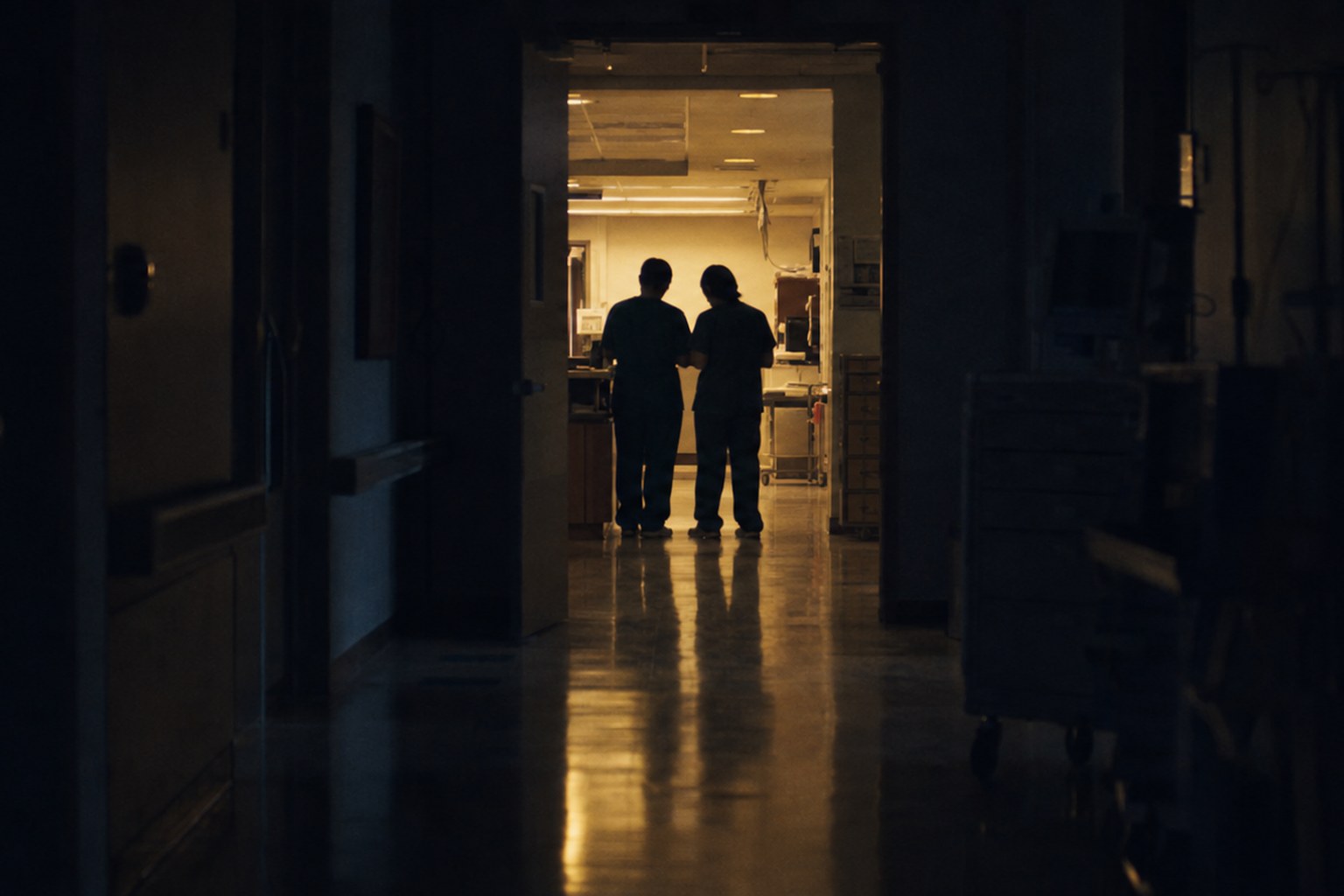
The same ward, with the weight distributed.
One button, in the ear. For the clinician between rooms; for the family in the car park afterwards. No appointment, no referral, no record. URIEL knows this person’s blind spots, values, triggers and what they need in order to believe they have done well — established through structured assessment at onboarding, not inferred from what they type. The institution sees none of it, and neither does the other side of the conversation. The depth is only usable because the boundary is absolute.
Telling a family the cancer is back.
He is the instrument of the worst news of their lives and there is no professional convention for what he does with that afterwards.
It is named in the corridor rather than carried into the next room. Putting the state into words engages the regulation that suppressing it does not.
Four minutes later, the next room.
A different family, a different prognosis, and a clinician still holding the last one. Presence is the whole treatment and it is the first thing to go.
Enough of a reset that the next family gets a clinician who is actually present. Not detachment — the recovered capacity to be there without being consumed.
The family, in the car park.
Nobody hands you a manual for the worst year of your life. Anticipatory grief has no socially permitted place to go.
Somewhere to put it at two in the morning, and language for the conversations nobody prepared them to have. Support for the caregiver as a person, not as unpaid staff.
A clinician who is empty cannot be present, and presence is not a bedside manner. In this ward it is part of the treatment.
Why it holds
It does not make the ward lighter. It is built to bring the decision back to the deliberate reasoning that can still make it.
The section that follows is the same on every URIEL page, and deliberately so. The environments differ. The physiology does not.
Under acute stress the prefrontal cortex — the part of the brain that holds several options in mind at once and weighs them against each other — measurably loses ground to faster, cruder threat circuitry. Working memory narrows. Cognitive flexibility drops. This is not a character failure and it is not a training gap. It is physiology, and it arrives precisely when the decision is most expensive.
Arnsten, Nature Reviews Neuroscience, 2009 and Nature Neuroscience, 2015; Shields, Sazma & Yonelinas, meta-analysis, Neuroscience & Biobehavioral Reviews, 2016
01
It gets said while it is still live.
Not at the debrief. Not at the annual review. In the corridor, between the room where it happened and the next one. Putting an internal state into words recruits prefrontal regulation over the threat response — an effect measured in the scanner, not asserted in a workshop.
Lieberman et al., Psychological Science, 2007; Torre & Lieberman, Emotion Review, 2018
02
The clinician steps outside the case.
Being inside an event and looking at one are different cognitive positions, and the second reasons better. It is why the same oncologist who cannot see their own week will give a colleague clear counsel about theirs.
Powers & LaBar, meta-analysis, Neuroscience & Biobehavioral Reviews, 2019; Crane et al., Stress and Health, 2022
03
The options are made legible. The clinician still decides.
URIEL issues no instructions and holds no clinical authority. It makes the alternatives and their consequences visible — the conversation with the family, the escalation, the honest limit — and leaves the decision with the person licensed to make it. Change a clinician arrives at holds. Change handed down does not.
Deci & Ryan, self-determination theory; Magill et al., 36 studies, N = 3,025, J. Consulting and Clinical Psychology, 2018
04
It happens again, and the capacity grows.
Regulation is a trainable capacity, not a temperament. In the training studies a single session’s effect is still measurable a week later, and it transfers to material that was never rehearsed. Those were structured laboratory protocols. What repetition does over a year on a live service is the question our trial is designed to answer.
Schweizer et al., Journal of Neuroscience, 2013; Hermann et al., N = 85, SCAN, 2020; Denny et al., Psychological Science, 2015
These are established mechanisms in the published literature, and each is cited above. What the literature does not yet contain is a trial of the assembled capability in an oncology service. That study is designed and is the next step, and we would rather say so than imply otherwise. The full evidence base, with the limits stated.
The return
What the institution gets for it.
Self-efficacy is the lever, and it is measurable.
Across 114 studies and 21,616 people, belief in one’s own capability tracked a performance gain of roughly 28 percent — against 10.4 percent for goal-setting and 13.6 percent for feedback. It is the largest single psychological lever in the organizational literature, and no cancer center is instrumented to move it.
Stajkovic & Luthans, meta-analysis, Psychological Bulletin, 1998
Structured reflection is not soft. It has effect sizes.
Meta-analysis puts goal-directed self-regulation at g = 0.74, the largest gain of any outcome category studied. Restricted to randomised controlled trials only, the overall effect holds at g = 0.59 across 2,528 participants. Moderate, replicated, and pointed at the capacity your clinicians are running out of.
Theeboom, Beersma & van Vianen, 2014; Kleingeld et al., RCT-only meta-analysis, N = 2,528, 2023
Availability is not a convenience feature. It is the dose.
In the motivational-interviewing literature, 87 percent of studies with more than five contacts showed an effect. With a single contact, only 40 percent did. An annual wellbeing day is one contact. This is available every day, including the one that ends in the corridor.
Rubak et al., 72 randomised controlled trials, British Journal of General Practice, 2005
The constraints we design around
What this environment will not tolerate.
URIEL is built for one environment at a time. This was the first. The limitations below are not obstacles to a general product; they are the specification for this one.
There is no interval
A clinician gives a family the worst news of their life and is due in the next room before that family has stood up. The schedule does not acknowledge that the first conversation happened, and anything that assumes a moment to absorb it has been designed for a day nobody here has ever worked.
Grief is not a recognized absence
A nurse can care for someone for three years and still not be family, so when that person dies there is no leave, no cover, and nothing on the schedule that changes. Anything that asks a clinician to name that loss is asking them to claim a grief the institution has never agreed exists.
Nothing may sit near the treatment decision
Every input touching a treatment choice has to survive legal review, and anything that could later be argued to have influenced one becomes a regulated product overnight. That boundary is not a disclaimer at the bottom of a page. It is the first thing the work is built against.
Adjacent environments
Built separately, and standing next to this one.
URIEL is specified separately for every environment it enters. Two of them sit close enough to this ward to matter.
Begin an institutional conversation.
Deployments are scoped with the institution, under its governance, and inside its data protection posture.
Begin an Institutional Conversation